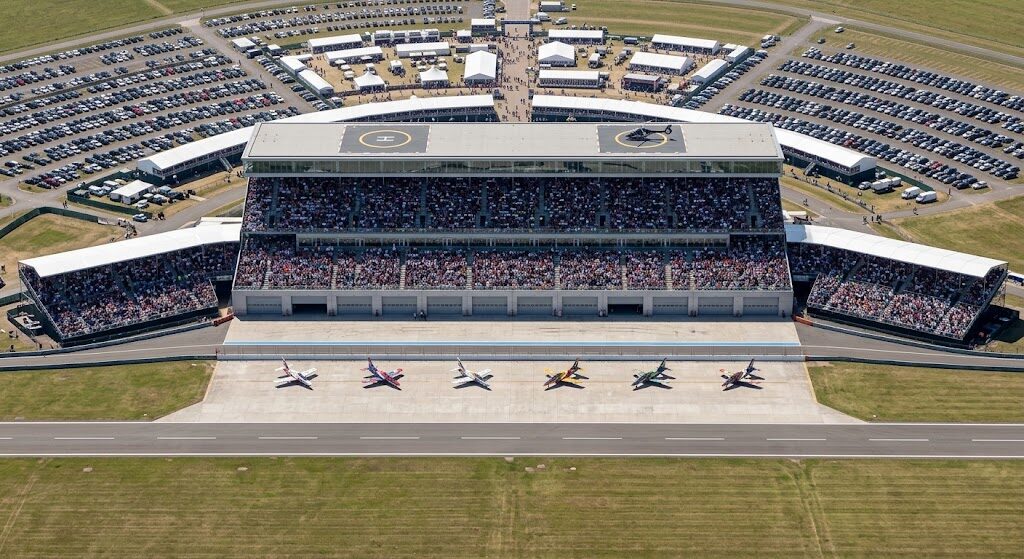
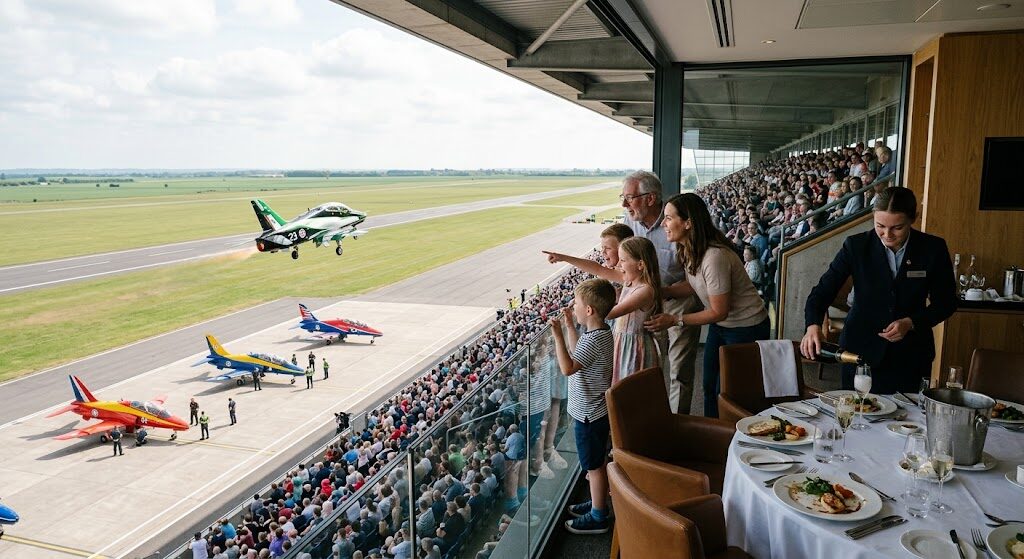
Concept visualisation of JWC Stadium
In development · first host city in progress

Something is
being built
for this sport

Aerial competition has never had a home. In a few years, it will have this one.

Thirty thousand seats facing a two-thousand-foot runway. Ten team garages directly beneath the crowd. A rooftop you arrive on by helicopter. It exists in drawings, in numbers, and in the images below — and the first one is already in motion.

Scroll
The idea
Every sport that matters eventually builds the place it belongs.

Football built its cathedrals. Motorsport built its circuits. Aerial competition has been borrowing airfields — brilliant ones, but borrowed. This will be the first venue designed from nothing around what actually happens on a championship weekend: aircraft, crowd, gamers, and four hundred feet of tarmac between them.

The vision

One side of the sky

Every seat will face the same direction, because nothing should hide the action. There will be no stand on the far side of the runway — just open ground, so the aircraft always have somewhere to go and the crowd always has a clean view. It sounds simple. No venue in the world is built that way.

30,000seats, one side only
420 ftfront row to the strip
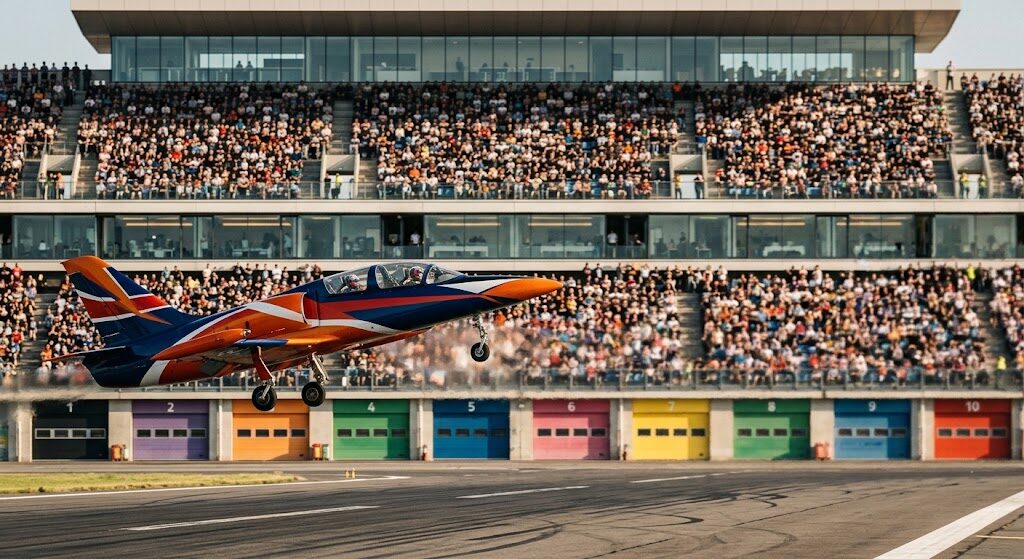
10garages beneath the crowd
2helipads on the roof
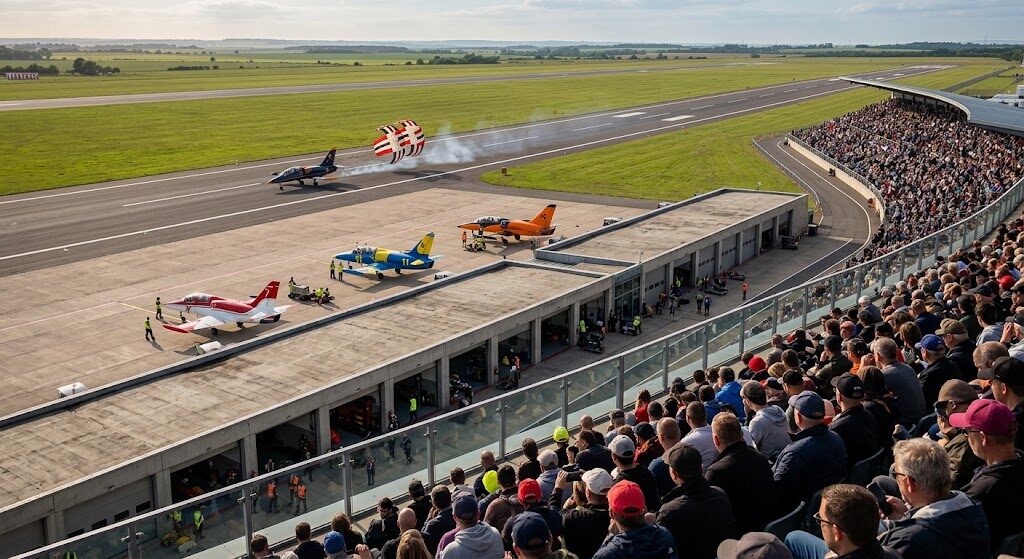
Concept: a jet on the display line in front of the grandstand
What it will look like

The runway will be the pit straight

Rotation, touchdown and drag-chute rollout will all happen directly in front of the stands — not somewhere out on a taxiway you can barely see.

What it will feel like

Close enough to feel it through your chest

These are visualisations, not photographs — the venue does not exist yet. But every one of them is drawn from the real design: the same dimensions, the same sightlines, the same building.

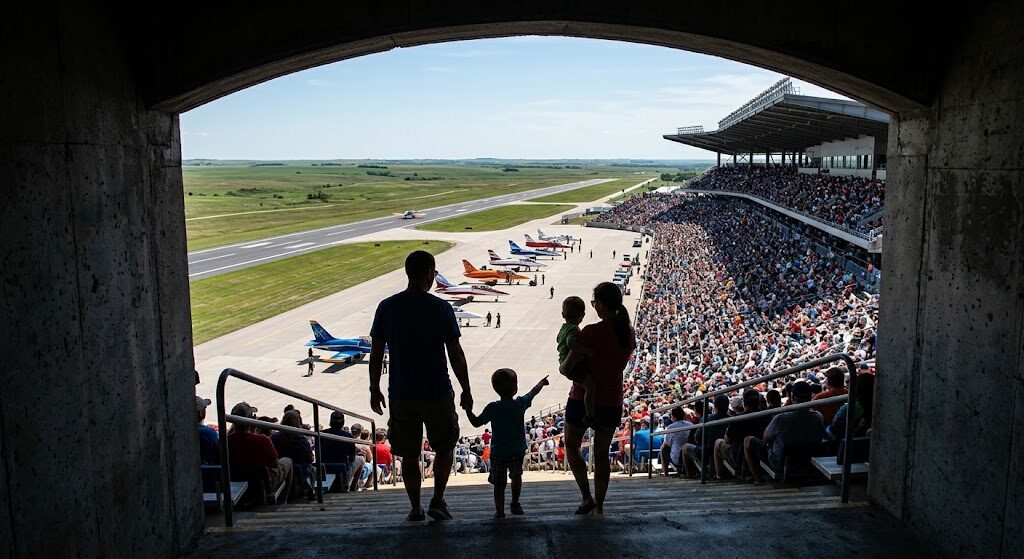
You will climb the stairs, and stop

Out of the tunnel and the whole strip opens at once — jets staged on the apron, the runway beyond, open country past that. Everyone who has walked into a great stadium knows this moment. Here you will get it with six aircraft in front of you.

Concept: emerging into the bowl
Concept visualisation

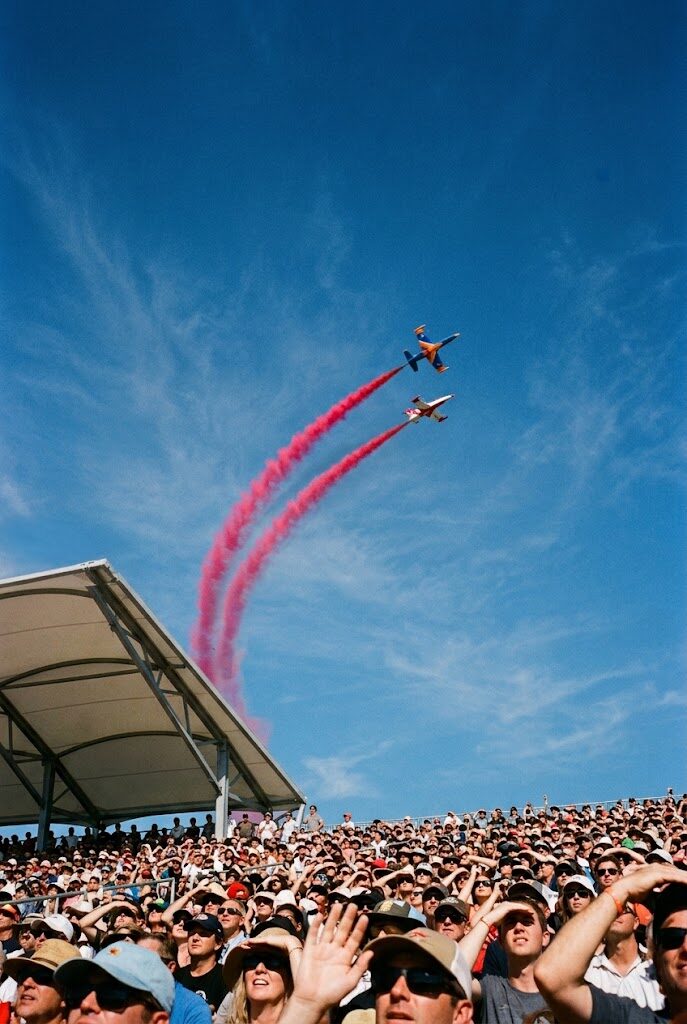
The battle will happen above you

Competition airspace will reach five miles out and a mile back over the stands, high above the crowd. You will spend a good part of the afternoon looking straight up — and the screens across the runway will tell you who just scored.

Concept: combat overhead
Concept visualisation

The paddock will be a window, not a wall

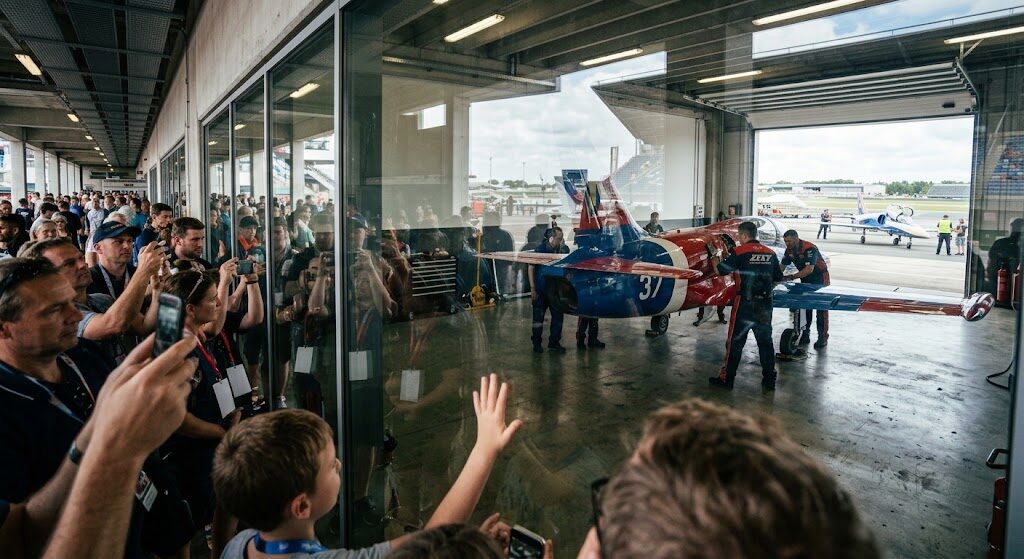
Teams will work with their backs to glass on the public concourse. Reload, checks, launch — on the clock, two meters from anyone who wants to watch, with thirty thousand people sitting on the roof above them.

Concept: pit-view gallery
Concept visualisation

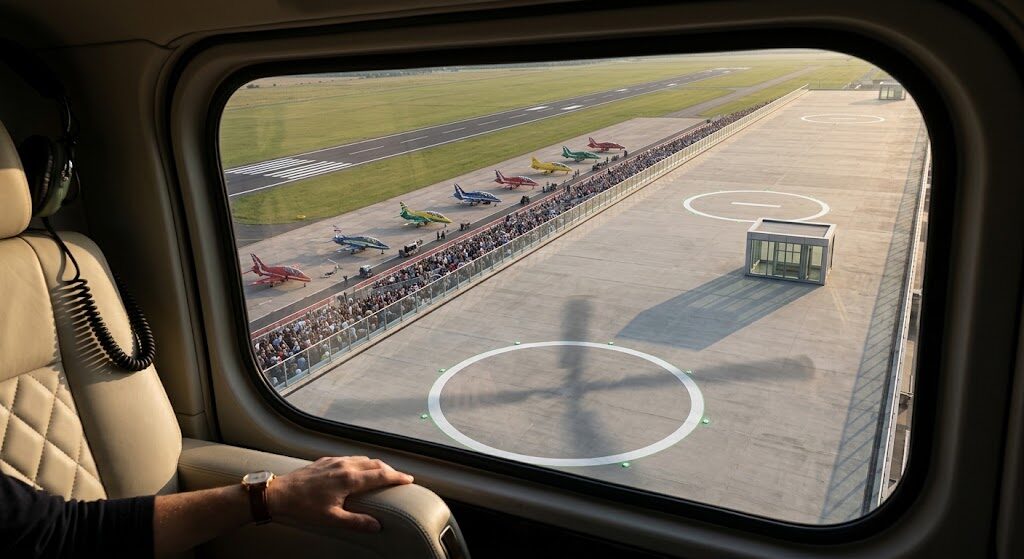
And some people will arrive on the roof

Two helipads, flush on the stadium roof and set back over the rear of the building — so the arrival never crosses the crowd. One lift stop down: a glass lounge running the entire crest, with the bowl falling away beneath it.

"The jets will land while you're still deciding on the wine."
Concept: arriving by helicopter
Concept visualisation
Ninety seconds

What one launch will actually be like

Not the highlight reel — the real thing, from the moment the garage door lifts to the moment the sound reaches the back of the stand. This is the sequence the whole building is designed around.

T − 90
The door lifts

The garage door rolls up directly beneath row 1. Whatever conversation was happening in those seats stops. Inside: the aircraft, the crew, the tool carts, all of it lit like a stage.

T − 70
Out into the light

A tug walks the jet forward onto the pit lane. A marshal holds the wingtip. It passes maybe forty meters from the front row, close enough to see the pilot's name on the canopy rail.

T − 45
The canopy comes down

Pilot in, straps on, canopy sealed. Somewhere behind the concourse glass, their gamer is already in the pod with the tactical picture live. The two of them are now one competitor.

T − 30
Start

The engine lights. You feel it before you properly hear it — a low pressure in the chest that arrives ahead of the noise. Thirty thousand phones come up at once.

T − 10
Lined up

The jet rolls onto the strip and stops square in front of the stand. For a few seconds nothing happens at all, which is somehow the loudest part.

T − 0
Full power

Brakes off. The afterburner lights and the sound arrives as physical force — through the seat, up through your feet, into your sternum. It accelerates past you in about four seconds and rotates almost exactly in front of the main stand.

T + 8
Gone

Gear up, into the turn, climbing away over empty ground. The noise keeps arriving for a moment after the aircraft has left, rolling across the stands from one end to the other.

T + 40
And below you, it starts again

The garage the jet came out of is already resetting for its return. You can watch that happen through the glass on your way to get a drink.

To put it another way

Things you already know the size of

Closer than the front row at a Grand PrixAn F1 car passes a grandstand about 15 meters away at 300 km/h. Here the aircraft is further out — but it's fifty times the size and it goes vertical.
Louder than a cup finalA full stadium roar sits around 100 decibels. A jet at full power from a few hundred feet is felt as much as heard — ear protection is part of the day, and it's free at the gate.
Your seat sits over the garageLike a Monaco balcony above the harbour, except the thing below you is a competition team on the clock with a jet in pieces.
A runway you could see the end ofTwo thousand feet — about the length of six football pitches laid end to end, and all of it in your field of view at once.
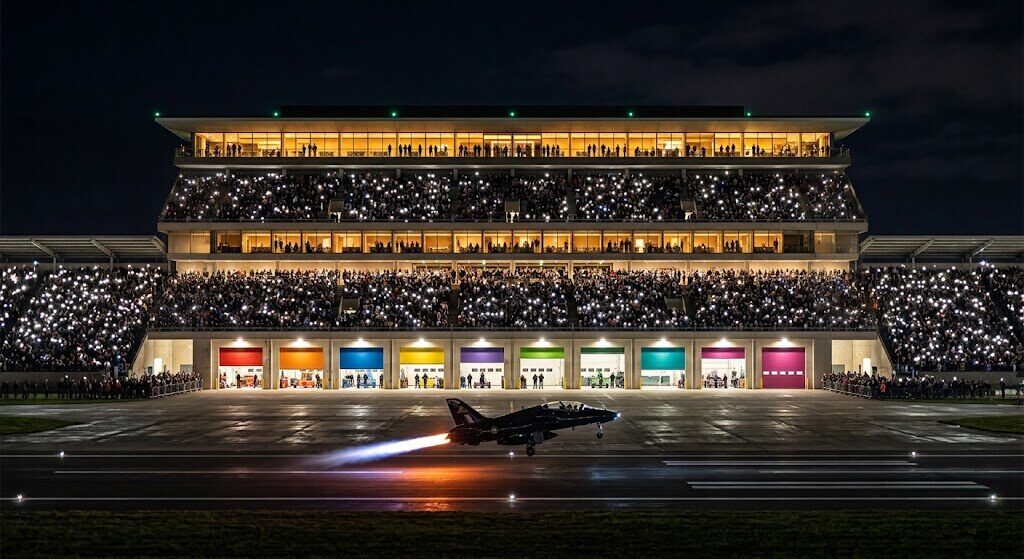
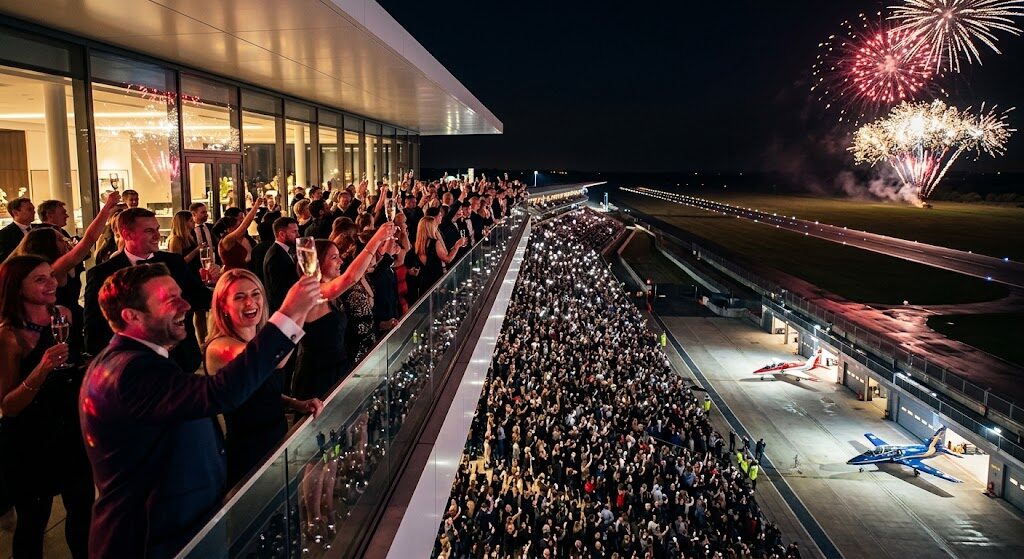
Concept: night launch
And then the lights

Imagine this at night

A wall of light behind every launch — garages, bowl, suites and lounge stacked above the tarmac. This is the image the host city will put on its posters.

The building

A grandstand with a sport underneath it

One structure will carry everything: garages at ground level, the crowd fused directly on the garage roofs, a band of glass suites through the middle, a lounge along the crest, and the helipads above that. Lower wings will extend the crowd along the runway on either side.

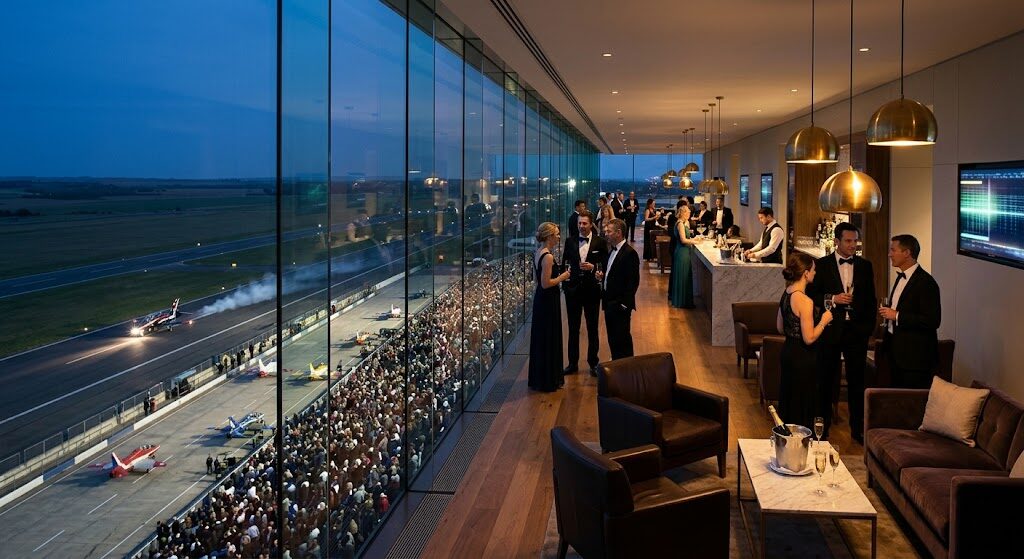
Concept: the Skydeck lounge
On the crest

The Skydeck

A glass lounge and open terrace along the entire top of the stadium — the highest and closest view the sport will have.

Concept: a private suite
Mid-bowl

The Suites

Forty private boxes set into the middle of the seating, each with a terrace over the pit lane and rotation at eye level.

Concept: the bowl
Above the garages

The Bowl

Seating will begin twelve meters up, on the roof of the garages — clear of the blast, close enough to fill your field of view.

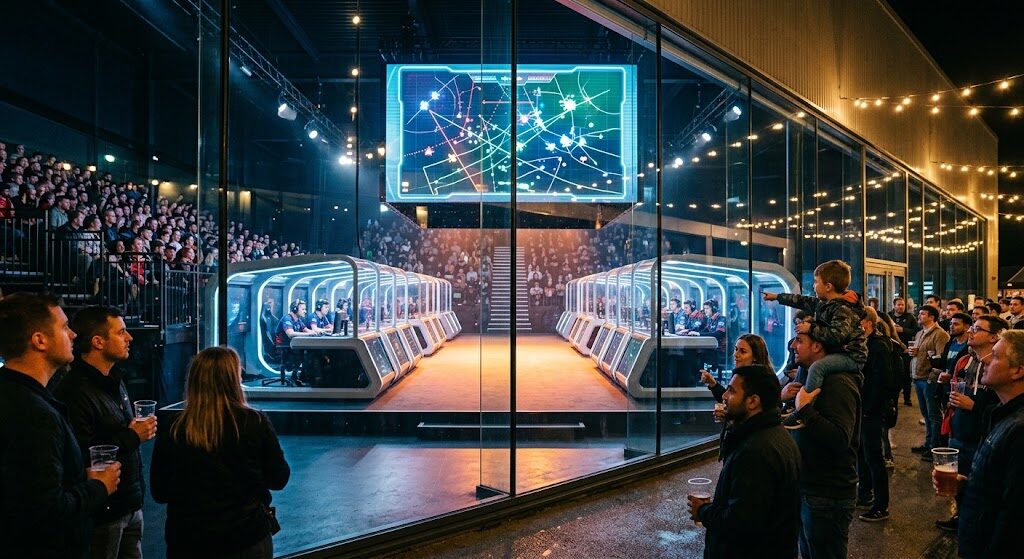
Concept: the Gamer Arena
Ground level

The Gamer Arena

Half of every team is a gamer. Their arena will front the concourse in glass, so the digital battle plays to the crowd all day.

Sky Village

The half of it with no seats at all

Behind the stand there will be a festival district, open from gates to last shuttle — because a championship weekend should be a day out, not two hours in a chair. It is also the answer to weather: when the sky closes, nothing here stops.

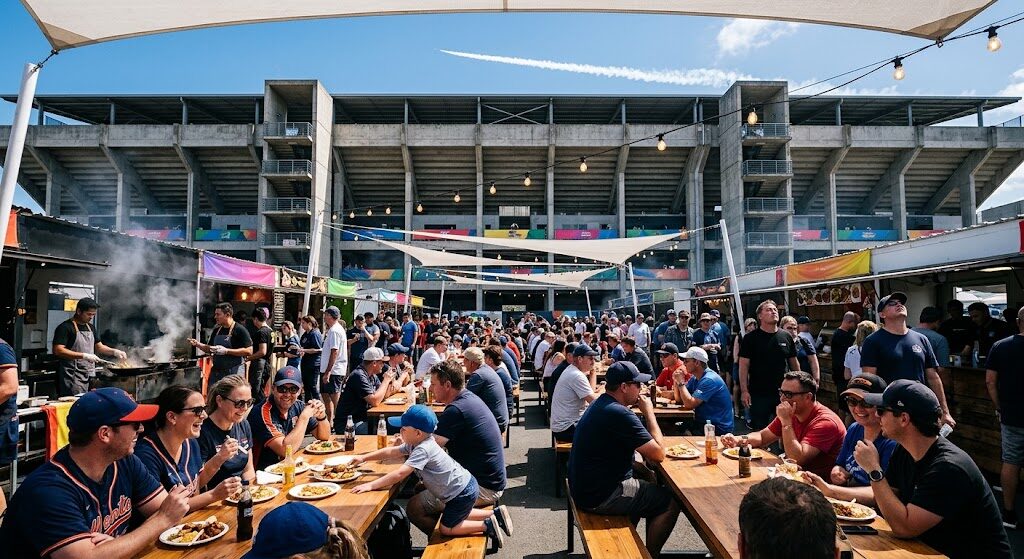
Concept: food halls

Food Halls

Open kitchens and communal tables under shade sails, with a smoke trail crossing the sky above the stands.

Concept: sim zone

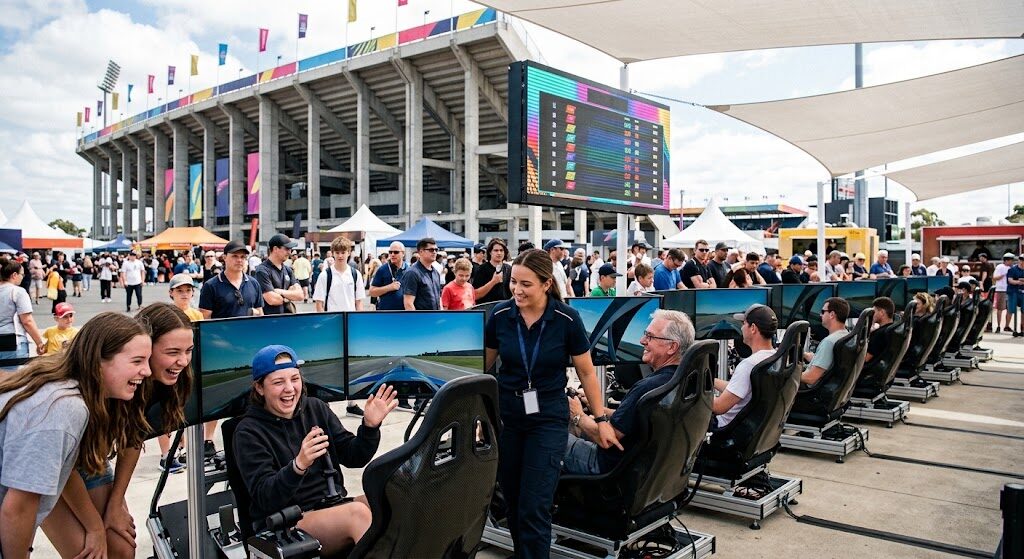
Sim Zone

Public rigs where anyone can fly the corridor and post a time. The cheapest way into this sport that will exist.

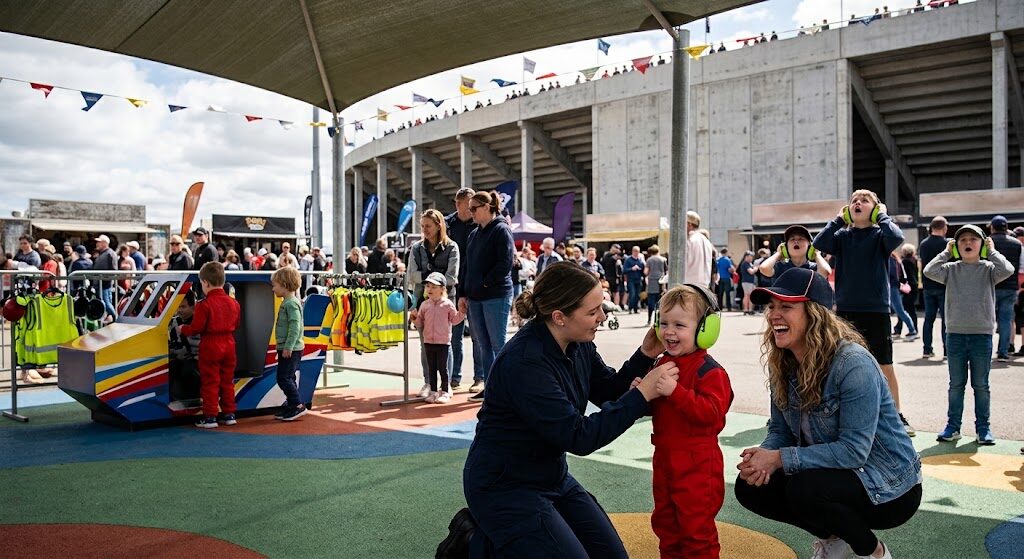
Concept: kids flight academy

Flight Academy

Ear defenders for the smallest ones, cockpit mock-ups, junior marshals. Where a lot of future pilots will start.

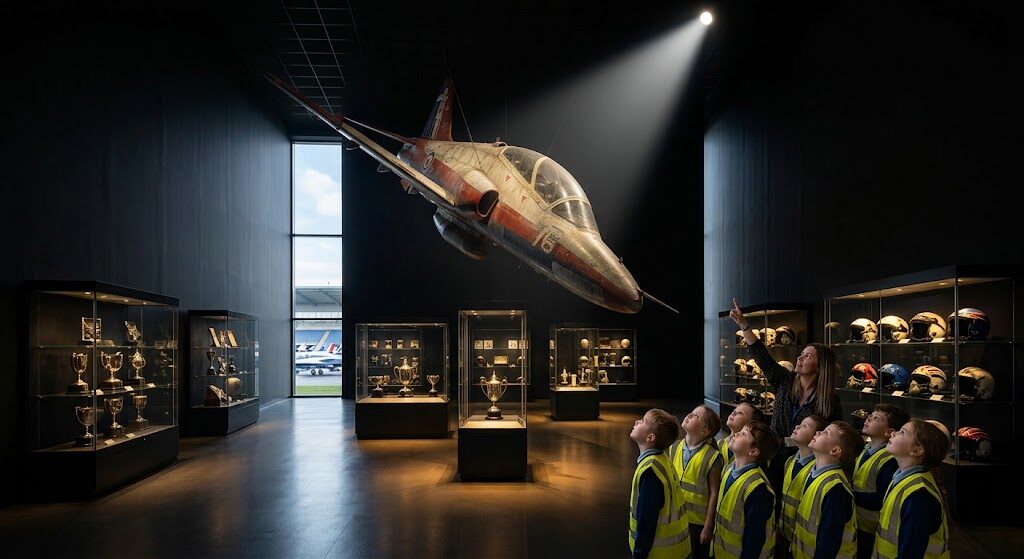
Concept: hall of champions

Hall of Champions

A museum for a sport young enough that its first champions are still flying. Their aircraft will hang here eventually.

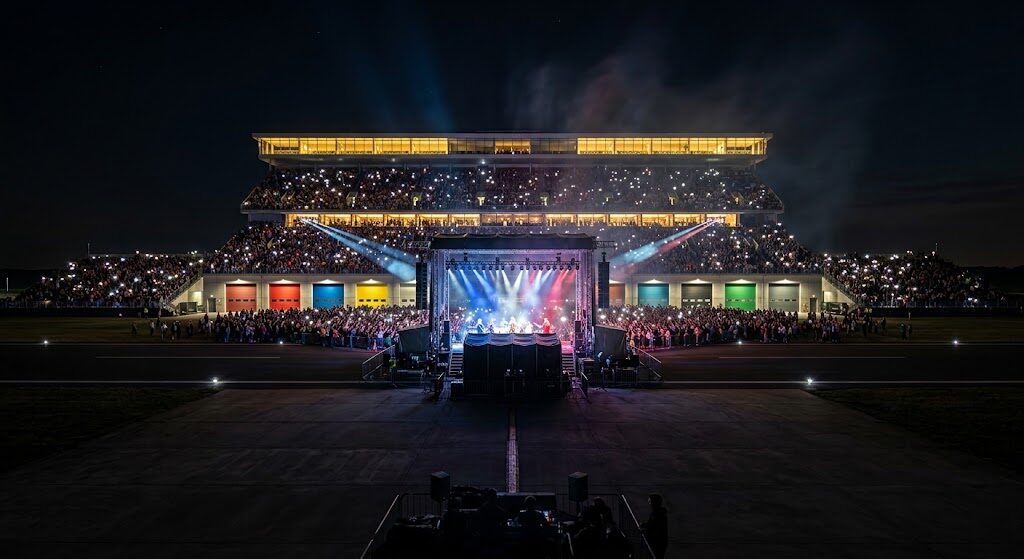
Concept: concert on the apron
The other 361 days

It won't sit empty

A stage on the apron with the full bowl behind it. A flying school on weekdays. Esports through the winter. A stadium that only works four days a year isn't worth building — this one is designed for the whole calendar.

One way it might go

The kid at the sim rigs

She is eleven, and she is not here for the jets. She is here because her dad is, and because there was a promise of chips.

At ten in the morning the aircraft are still in their garages, so they walk the village. There is a row of simulator rigs near the food halls with a screen above them showing a leaderboard, and a queue of adults waiting. Somebody hands her a headset because the queue is long and she is small and it seems like a kind thing to do.

She flies badly. Then slightly less badly. On her third run she puts a time on the board that beats two grown men behind her, and the whole row makes a noise about it, and something happens in her chest that she will not have words for until much later.

At one o'clock she watches a jet leave the ground four hundred feet from where she is standing, and she feels it come up through the concrete. At three she presses her face to the glass behind the garages and watches six people rebuild something in ninety seconds. At five she asks, in the tone of someone who has already decided, whether the person flying it started somewhere.

Half of every team in this sport is a gamer. That is not a marketing line — it is the actual structure of the competition. The rig she sat in at ten in the morning is the same discipline as the pod behind the glass, and the pod behind the glass is the same team as the aircraft.
Most stadiums sell a view. This one is built so that the distance between watching and doing is about six meters and one open door.
When

From drawing to first flight

The design is complete and costed, and the first host city conversation is live. From signature, the build runs thirty months.

Now
Design complete · first city in progress

Site plan, cross-sections, airspace case and full cost plan finished — and active work underway with our first host city.

Next
Location announced

Land committed, consents filed, design-build contract awarded. This is the moment the countdown really starts.

+14 months
The runway goes live

Airside certified first — so teams can test, and the first images of real aircraft on the real strip appear a year before opening.

+24 months
The stand tops out

Garages, bowl, suites and lounge complete. Fit-out and the Gamer Arena follow.

+30 months
The first championship weekend

Gates open. Thirty thousand people find out what this feels like at the same moment.

The small things

The promises nobody usually makes

Big claims are easy. These are the details that decide whether a family actually enjoys the day — and they are in the design, not the marketing.

Ear protection at the gateFree, for everyone, and fitted properly for small children at the academy. The noise is the point — that doesn't mean anyone has to endure it.
A quiet room with a viewSensory-friendly space behind glass, so anyone who needs the volume turned down can still watch the sport.
Every seat under coverFull canopy across the bowl. Sun or rain, you are not standing in it.
The day doesn't stop for weatherIf flying pauses, the Gamer Arena keeps running and the village keeps going. You will not be sitting in a wet chair waiting for an announcement.
Step-free, everywhereAccessible parking at the centre gate, accessible and companion seating at every level, and platforms with a real sightline — not a corner.
Under-5s freeAlong with nursing rooms, a supervised academy zone, and a village that keeps children busy for three hours before anything flies.
For wherever it lands

What it will mean for the city that builds it

A stadium that only wakes up four days a year isn't worth the land. This one is a certified airfield with a flying school, an esports arena, a museum and a concert venue attached — open all year, staffed locally.

2,000+construction jobs at peak, over a thirty-month build
250permanent roles once open, plus around 3,000 per event weekend
60,000hotel room-nights across a single championship weekend
365days a year of flying school, testing, esports, concerts and school visits
Where we are

The first one is already in motion

The design is complete and costed, and we are actively working with our first host city to open the first JWC Stadium in the near future.

When the location is announced, this page will be the first place it appears.

Future host citiesBeyond the first, we are opening conversations for additional facilities. Full design package and business case on request.
PartnersNaming rights and founding partnerships are open conversations.
MediaRenders, drawings and briefing materials available for press use.
stadium@jetworldchampionship.com

For everything else, follow the Jet World Championship.

Concept: the finale

See you on the first night

/section>
Concept: the finale

See you on the first night